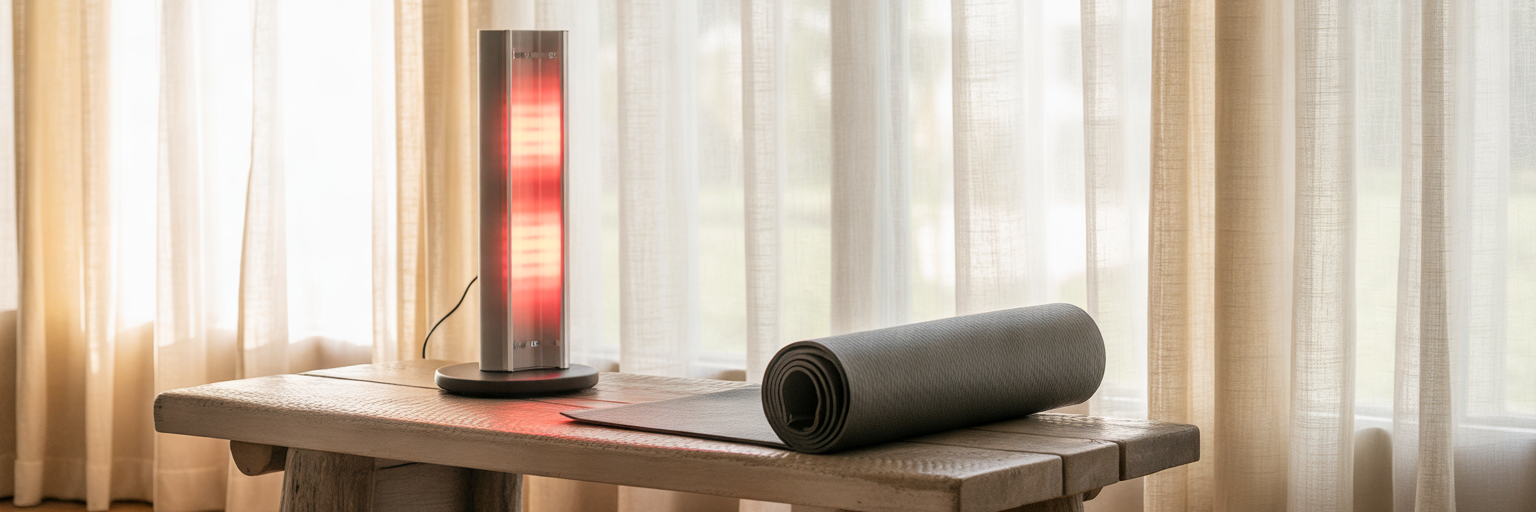
NASA researchers in the 1990s originally studied light-emitting diodes to grow plants in space before observing that the same red wavelengths accelerated tissue repair in astronauts. Understanding how that cellular mechanism translates to a living room setup is the key to selecting the right recovery hardware and finding the best red light therapy panel for your body.
Why Choosing the Best Red Light Therapy Panel Starts with How Your Body Heals
You know the feeling of swinging your legs out of bed and waiting a few seconds for your knees or lower back to catch up with the rest of your body. Or perhaps you finish a heavy gym session or a long Sunday run and notice that the deep muscle heaviness lingers until Wednesday, where it used to clear by Monday morning. You roll on a foam cylinder, apply a warm wheat bag, or spend twenty minutes stretching on the living room carpet. Those habits bring temporary relief to the surface, yet the underlying stiffness returns the moment you cool down because superficial warmth rarely addresses why the tissue is slow to rebound in the first place.
Beneath that stubborn tension is a straightforward biological bottleneck. Every muscle contraction, tendon recovery cycle, and joint repair process relies on microscopic engines inside your cells called mitochondria. Their primary job is to convert nutrients and oxygen into adenosine triphosphate, the chemical currency your body spends to clear metabolic waste and mend everyday micro-damage. As you accumulate physical stress or move through your forties, fifties, and sixties, those cellular engines become less efficient. Oxidative stress builds up inside the cell and slows energy production right when your tissues need it most. You are left carrying a backlog of physical fatigue that stretching alone cannot resolve.
When you begin researching home recovery equipment Australia wide to address that cellular slowdown, the sheer noise of the 2026 market makes a simple concept feel unnecessarily complicated. People prepared to invest anywhere from $500 to over $5,000 are immediately confronted with aggressive sales pages boasting massive LED wattages, six or eight proprietary wavelengths, and medical-sounding badges that rarely explain how a unit actually performs in a bedroom or home gym. As we explain in our foundational guide to using red light therapy at home, photobiomodulation is not a miracle cure, nor does it require a degree in optical physics to use effectively. Choosing the best red light therapy panel simply starts with understanding how specific bands of light interact with human tissue so you can match honest, well-engineered hardware to your physical routine.
What Light Depth and Real Power Output Mean for Stiff Joints and Tired Muscles
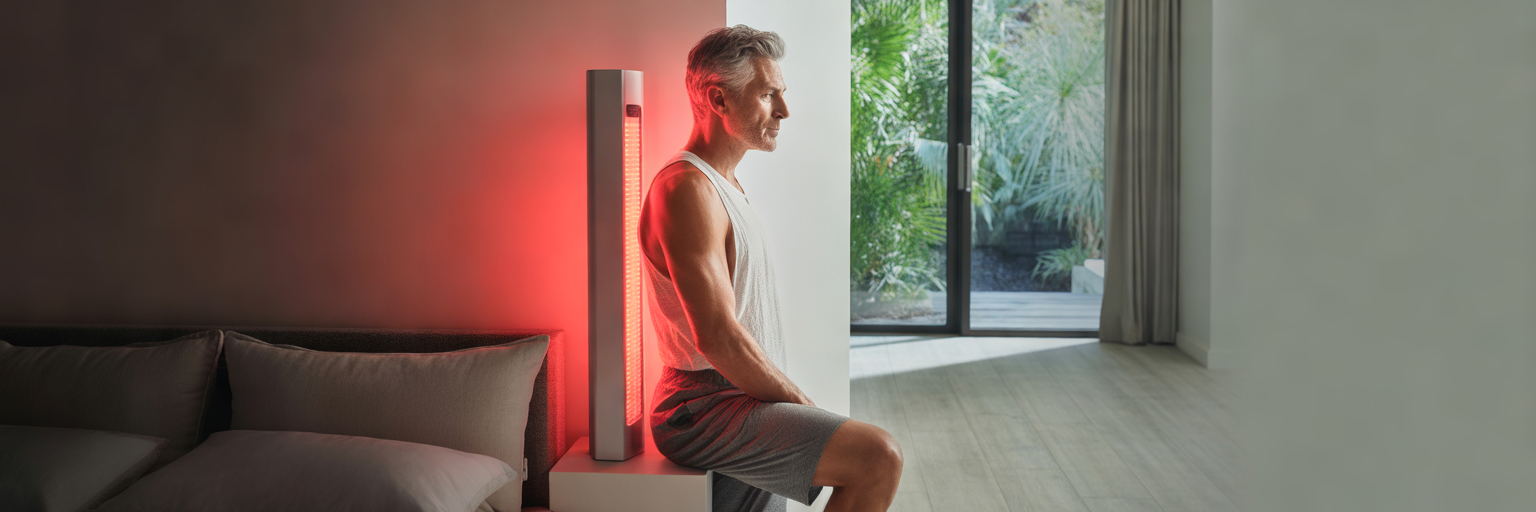
How Wavelengths Target Surface Skin Versus Deep Tissue
Light is not a uniform blanket that warms everything equally. How deeply photons travel into your body depends entirely on their wavelength, measured in nanometres. Across the natural world, long red wavelengths behave uniquely depending on the medium they pass through; as documented by Nature Is Crazy, certain deep-sea dragonfish even produce specialised long-wavelength red bioluminescence to hunt in dark water where shorter wavelengths are rapidly absorbed. Inside human tissue, light encounters a different set of barriers made of water, haemoglobin, and melanin, which is why home recovery panels rely on a specific optical window spanning visible red and invisible near-infrared light.
Visible red light sits between 630 and 660 nanometres. Because human skin absorbs these shorter waves quickly, they concentrate their energy in the epidermis, dermis, and shallow capillary beds. That makes the 630 to 660 nm range ideal if your primary goal is supporting skin elasticity, calming surface redness, or assisting superficial wound healing. If you are trying to reach a tight hamstring, an irritated Achilles tendon, or a stiff knee joint capsule, visible red light loses most of its momentum before arriving at the target.
Reaching those deeper structures requires near-infrared light between 810 and 850 nanometres. These longer waves pass through the outer layers of skin with far less scattering, delivering photons several centimetres deep into dense muscle bellies, connective fascia, and bone surfaces. Because near-infrared light is invisible to the human eye, the LEDs on your panel will appear dark or show only a faint pink pinprick at the core, even when operating at full capacity. A capable dual-chip or multi-wavelength panel blends both ranges so your surface circulation and deep musculoskeletal tissues receive light simultaneously.
Why Irradiance at Distance Matters More Than Bulb Wattage
Having the right wavelengths means very little if the light lacks the momentum to reach your cells when you stand a comfortable step away from the unit. This is where many buyers get caught by the rated bulb wattage trap. A manufacturer might advertise a 1,500-watt panel simply because it contains 300 individual five-watt LEDs. Running those diodes at full theoretical capacity would melt the housing, so engineers drive them at a fraction of that number. Even power consumption measured at the wall socket only tells you how much electricity the machine draws, not how much therapeutic light actually lands on your skin.
The specification that dictates real-world tissue penetration is irradiance, which measures power density in milliwatts per square centimetre (mW/cm²) at a specific distance. Be cautious when comparing charts: some brands measure irradiance using budget solar meters that inflate readings by nearly double, while transparent manufacturers publish third-party spectrometer data taken at a realistic standing distance of 15 to 30 centimetres. You can see how this optical honesty plays out in practice in our side-by-side comparison of Joovv and Mito Light, where verified spectral output and beam uniformity matter far more than raw diode counts.
According to a 2026 review of clinical panel parameters by Forbes Vetted, aiming for roughly 80 to 100+ mW/cm² at your normal standing distance allows you to collect a meaningful cellular dose within a practical 10 to 20 minute window. That time limit matters because photobiomodulation follows a biphasic dose response. Think of it like watering a potted plant or warming cold hands near a campfire. Too little exposure leaves the soil dry, the right amount stimulates healthy growth, and flooding the pot for an hour drowns the roots and halts the benefit. Standing in front of a panel for forty minutes does not double your recovery; once your mitochondria absorb their optimal photon quota, extra light simply causes the cellular response to plateau or diminish.
Because cellular changes accumulate quietly over weeks rather than producing an instant jolt, many Australians pairing red light therapy for home recovery with broader healthy ageing goals choose to measure what is happening under the hood. Services such as Mito Health allow you to track baseline blood biomarkers and systemic inflammatory indicators over time, giving you objective feedback alongside how your joints and muscles feel each morning.
| Specification | Red Light (630–660 nm) | Near-Infrared Light (810–850 nm) |
|---|---|---|
| Primary Tissue Depth | Superficial absorption (skin dermis and surface capillary beds) | Deep penetration (muscle bellies, tendons, and joint capsules) |
| Visual Appearance | Bright crimson glow visible to the human eye | Invisible or faint pink dot at the LED core |
| Target Irradiance at 15–30 cm | 80 to 100+ mW/cm² verified by spectrometer | 100+ mW/cm² verified by spectrometer |
| Optimal Session Window | 10 to 15 minutes for surface tissue | 10 to 20 minutes before biphasic diminishing returns |
How Panel Size and Mounting Setups Shape Your Daily Recovery Routine
Specs on a screen tell you what a panel can do in a laboratory, but its physical footprint determines whether you will still be using it six months after the courier drops it off. The biggest threat to any home recovery investment is daily friction. When you get home at six in the evening with tight calves or an aching lower back, you will not spend ten minutes dragging a heavy steel chassis out of the wardrobe, propping it against a stack of books on the floor, and untangling extension cords. If the unit is not ready to switch on where you naturally stand or sit, it will eventually collect dust.
Start by matching the coverage area of the chassis to how your body actually experiences fatigue. A compact tabletop panel measuring 30 centimetres tall usually costs between $400 and $800 and works well if your goal is highly specific. You can set it on a bedside table or desk to target a single sore knee, an elbow tendon, or your face while listening to a morning podcast. The limitation becomes obvious the moment you try to use that same small box for systemic post-run or post-gym muscle recovery. Covering your quads, hamstrings, glutes, and lower back with a desktop unit requires four or five separate 15-minute positions. Turning a quick recovery habit into a clunky 75-minute chore guarantees you will start skipping sessions.
If you want whole-body recovery, morning circadian light exposure, or relief across multiple joints at once, a mid-sized half-body panel or a full-body modular array in the $1,500 to $4,500+ bracket changes the daily rhythm entirely. You stand or lie in front of the array once for ten minutes on your front and ten minutes on your back, and you are done. When evaluating red light therapy panels Australia wide, you also have to consider how a large electrical appliance behaves inside an Australian room. Ensure the system is built natively for 230V/240V 50Hz local power with proper Australian plugs rather than relying on flimsy travel adapters. Pay attention to cooling fan decibels and heat dissipation too. While LEDs do not heat the room like a sauna, a large bank of internal drivers running in a compact study during a humid Brisbane or Sydney January still needs breathing room and quiet airflow so your session remains relaxing.
Before committing your budget, we always recommend running a thorough red light therapy comparison across at least three suitable systems in our directory of red light therapy panels and answering four practical setup questions:
- Where are your primary pain or fatigue points? Single joints and facial routines suit compact tabletop units, whereas hips, backs, and full-leg recovery demand a panel at least 90 to 150 centimetres tall.
- Do you prefer to stand or lie down during recovery? Standing setups work well with door hooks or vertical floor stands, while exhausted evening users often prefer a wheeled horizontal stand that rolls over a bed or treatment mat.
- Can your internal doors support the weight? Many mid-sized panels weigh 8 to 15 kilograms; hollow-core internal doors common in newer Australian homes can bow or rattle under heavy over-the-door brackets, making a dedicated floor base a safer investment.
- Where will the unit live permanently? Measure your wall clearance and power point distance before ordering so you know the unit can stay plugged in and accessible every day without blocking walkways.
Looking Past Marketing Labels to Electrical Safety and Australian Support
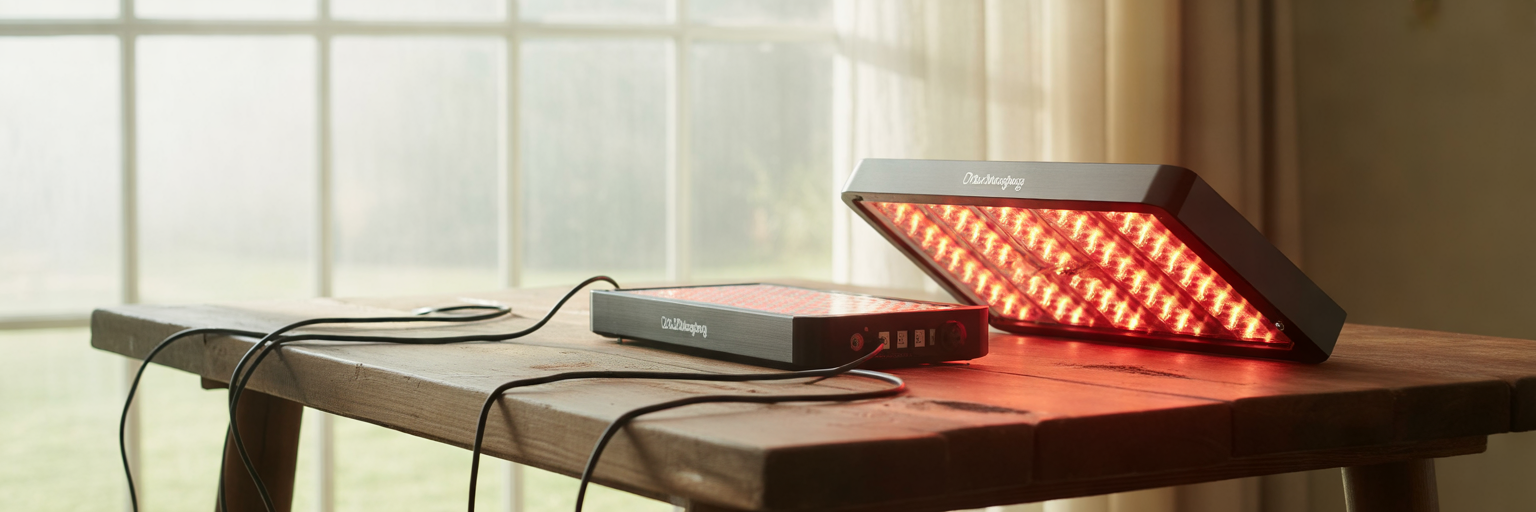
Once you narrow down the right size and irradiance bracket, the next step is stripping away pseudoscientific marketing badges to inspect how the machine is actually wired and supported. Almost every brand in this space stamps "FDA Registered" or "Medical Grade" across its checkout page. In plain terms, basic FDA registration simply means the factory filed an administrative form stating where the device is made; it is not a clinical endorsement that the panel outperforms a competitor. Discerning buyers look instead for recognised international electrical and optical safety standards, such as IEC 62471 for photobiological eye and skin safety and EN 60335-2-27 for household optical appliances.
You can feel the difference between budget internal electronics and proper engineering when you stand fifteen centimetres from an active array. Cheaper panels often cut corners on their internal power supplies, resulting in invisible high-frequency LED flicker as the alternating current cycles. Even when your conscious vision cannot detect that rapid strobing, your optic nerve and brain register it, which can leave you walking away from a session with subtle eye strain, visual fatigue, or a dull headache. Quality systems use constant-current zero-flicker drivers alongside shielded internal wiring that keeps electromagnetic field (EMF) emissions negligible at your actual standing distance. You can inspect how established manufacturers document low-EMF output, flicker control, and modular bracket engineering in listings like our profile of the Mito Red Light MitoADAPT series.
It is also sensible to remember that high-powered optical hardware is not appropriate for every person in every situation. While red and near-infrared wavelengths contain zero ultraviolet rays and cannot burn the skin the way sunlight does, anyone with an active photosensitivity condition, retinal disorder, or prescription for photosensitizing medications should speak with their GP or specialist before introducing concentrated light panels at home.
Finally, treat freight weight and warranty terms as core specifications rather than fine print. A solid steel full-body panel is a heavy piece of industrial electronics. If a driver or cooling fan fails eighteen months into ownership, you want clear protection under Australian Consumer Law and a brand that either maintains local warehouse support or explicitly covers two-way international warranty courier costs. Being asked to pay $350 out of pocket to air-freight a twelve-kilogram steel box back to an overseas depot turns a minor repair into an expensive headache. Run through these three verification steps before entering your card details:
- Confirm independent optical and electrical testing: Look for published spectrometer irradiance charts along with zero-flicker and low-EMF verification at 15 centimetres.
- Read the return and warranty freight policy: Verify at least a two-to-three-year warranty and check who pays for shipping if a heavy unit requires servicing from an Australian postcode.
- Check trial terms and restocking fees: Reputable brands offer a 30-to-60-day at-home trial window, though you should clarify whether a percentage restocking fee applies if you decide to exchange a small panel for a larger array.
Where Light Fits Alongside Cold and Heat in a Complete Home Setup
Even the most capable LED array has clear biological boundaries. Because photobiomodulation works by nudging mitochondrial energy production and modulating cellular signalling over weeks of steady use, it is a quiet background builder rather than an immediate physical switch. Standing in front of red light for fifteen minutes will not rapidly drop your core temperature after a scorching summer run, nor will it deliver the instant autonomic nervous-system jolt or rapid vascular flush that many active people crave right after heavy exertion. Understanding what light does not do prevents buyer disappointment and helps you see how different home systems complement one another.
If your immediate challenge after tough physical work is throbbing joint heat, acute swelling, or a wired stress response that refuses to settle, cold water immersion pulls a completely different physiological lever. Where light gradually feeds cellular repair, submerging in cold water triggers rapid vasoconstriction, quietens nerve conduction velocity, and forces an immediate parasympathetic rebound once you step out and warm up. We break down the timing and physiology of pairing both modalities in our detailed comparison of cold plunge versus red light therapy. For households where bags of servo ice are no longer practical, dedicated water chillers and insulated tubs from Plunge Chill keep water at a consistent therapeutic temperature on the back deck so you can handle acute post-session inflammation before using your light panel later in the day.
At the other end of the daily clock, recovery often comes down to how effectively you shed physical tension and drop your core temperature for deep sleep. You might finish your red light session in the early evening to wind down, yet still struggle with restless legs or warm summer bedrooms that fragment your rest. Rather than installing another heavy appliance, many people layer in portable thermal recovery gear such as Ice Blankets to draw excess heat away from tired limbs and settle the nervous system before bed. Each tool has a distinct job: cold manages acute thermal and vascular load, cooling layers support rest and downtime, and red light steadily rebuilds the cellular engine underneath.
Investing in home recovery hardware works best when you ignore the urgency of countdown timers and flashy influencer discounts. Take the time to map out where your body feels the most friction, measure the wall or floor space where a unit will actually live, and compare at least three transparent systems side by side across our directory at Personal Recovery Lab. When you match verified light output and practical mounting hardware to your real daily rhythm, you buy a piece of equipment that serves your body for years rather than just another gadget for the cupboard.